

Habit Tracking: The Difference Between Thinking About the Work and Actually Doing It
From The Quiet Creators Studio

Hey Friends,
Welcome to week seven of The Quiet Creators Studio.
For the past six weeks we’ve been building a framework. Five intentions—Intention, Active/Passive, Space, Ritual, Minimalism—that are meant to govern how I work and create.
But here’s the problem with frameworks: you can think about them endlessly without actually doing anything.
This week, things get practical.
A quick note: The Quiet Creators Studio is usually subscriber-only, but I wanted to make this week’s edition free. If you’ve been curious about what we’re exploring here—reconnecting with creative joy, fighting brain rot, building sustainable practices—this is a good place to start. See if it resonates. If it does, consider subscribing. If not, no worries. Either way, I hope you find something useful here.
From philosophy to practice:
I bought a notebook.
Not a productivity system. Not an app. A notebook. And in it I’ve started tracking the habits I want in my life—the things that, if I’m honest, I already know I want more of but somehow never seem to get around to.
Because here’s what I’ve noticed: the things you want most are often the first things you neglect. Not because you don’t care. Because normal life has a gravitational pull. Scrolling. TV. The passive drift of a day that just happens to you.
A habit tracker is just a way of reminding yourself to go do the things you actually love.
How I’ve set it up:
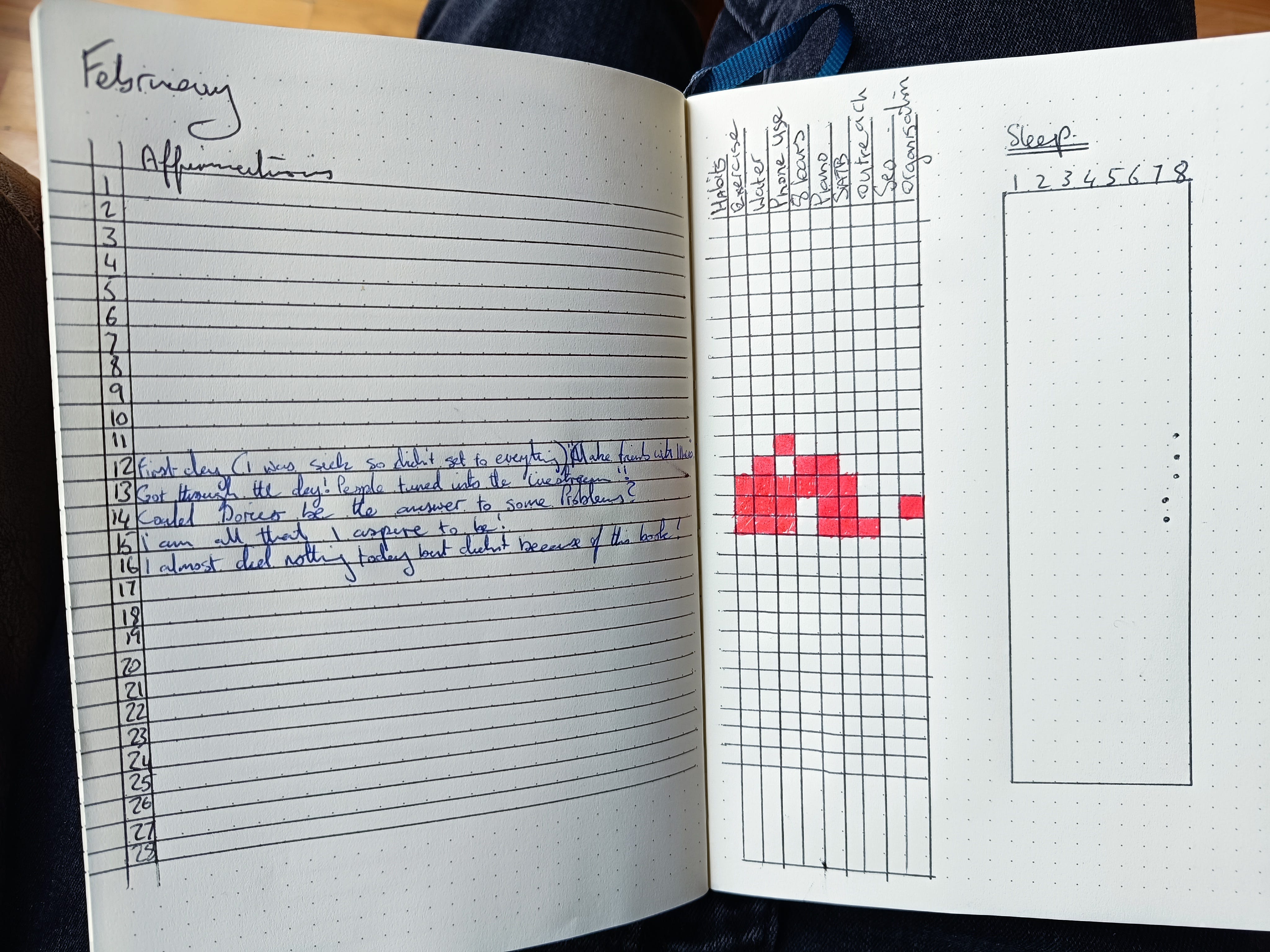
Two-page spread. Left side: a row for each day of the month with space for one daily affirmation or highlight. Something positive. Something I noticed or felt or made.
I’ve learned something about myself and journaling: I have a tendency to turn it into a washing machine of negative thoughts. I keep tonguing the sore tooth. Julia Cameron’s morning pages are brilliant for a lot of people but for me they became an excuse to fixate. So I’ve reduced it. One line. One positive thing. That’s enough.
On the right side: the tracker itself.
Here is a link to the Leuchtturm 1917 notebook. These are just incredeible quality!
https://leuchtturm1917.com.au/?ref=Barry+Power (This is an affiliate link, not sponsored)
Three pillars, nine habits:
I’m keeping it simple. Three pillars, three habits each. Nine total.
I’m not expecting to hit all nine every day. If I consistently get five or six, that’s a good day. And they don’t have to be the same five or six. The goal is to look at the month and see patterns—what I’m doing, what I’m avoiding, what needs more attention.
Pillar One: Health and Wellbeing
Exercise — any form, any duration. If I moved my body intentionally, it counts. I have my own subroutines but for tracking purposes it’s binary: did I do it or not.
Water — two litres a day. I’ve been managing about one litre consistently so this is a stretch goal. Simple to track, easy to forget.
Phone use — no phone after 9pm. I’ve set my screen to grayscale at nine o’clock as a trigger. I’m not tackling excessive daytime use yet. That’s too big to solve all at once. But if I can put it down at nine and not pick it up until morning, that’s a meaningful win.
Pillar Two: Art and Creativity
Piano — thirty minutes, metronome where possible. I’ve been working on Bach. Sight reading, fingering, getting back to fundamentals. Since moving more deliberately into composition ideation on a piano just makes so much sense.
SATB — soprano, alto, tenor, bass. Four-part harmony, Bach chorales, voice leading. The kind of compositional theory I know will deepen my orchestration work. Understanding chord voicing, the overtone series, extensions. This one is slow, deliberate study.
8 bars — one small composition in Dorico (trying it out as a possible move from Sibelius) every day. Just eight bars. Trying to apply the SATB thinking. Getting in the habit of finishing something, however small.
Pillar Three: Business and Development
Outreach — thirty minutes of active outreach. DMs, emails, research. Finding upcoming projects, putting myself in front of people who might need a composer. This is the hardest one to tick off. Everything else on the list is internal. This one requires showing up in the world. Four days in and it’s already the most avoided item on the tracker.
SEO — I have a lot of content. Live streams, blog posts, newsletters. The advice I’ve been given is to organise all of it properly on my website. Make it searchable. Clarify who I am, what genres I work in, what I’m good at. I haven’t started this yet. It’s on the list so I have to look at it every day.
Organisation — I’ve run out of hard drive space. All my drives, including my laptop, are clogged with years of accumulated files I can’t seem to move or delete. This is holding up my actual work. It needs to be done. Having it on the tracker means I can’t keep pretending it doesn’t exist.
What I’m noticing already:
Four days in and a pattern is already emerging. Health and creativity are getting ticked. Business and development are not.
Which means at the end of two months I have no right to complain about a lack of opportunities if I’m not consistently doing the things that create opportunities. The tracker makes that visible. It’s hard to argue with a page full of empty boxes.
There’s also a sleep tracker on the spread. I don’t have major sleep issues right now so it may not stay beyond this month. But it felt worth including while I’m setting the whole thing up.
Why this and not an app:
I tried apps. The friction of opening them, the notifications, the gamification—all of it pulls me back into the thing I’m trying to escape. The phone.
A physical notebook on my desk is just there. No algorithm. No engagement loop. Three minutes at the end of the day to fill it in. When you look at it every morning you see the whole month building up in front of you.
Im also a big believer in the speed of thought when thinking through handwriting.
The visibility is the point. Not perfection. Pattern recognition.
The practice this week:
Pick three habits you want more of in your life. Just three.
One for your health. One for your creative practice. One for your work or development.
Track them for seven days. Not in an app. On paper.
At the end of the week, look at what you did and—more importantly—what you didn’t do. Notice where the resistance is. Notice what you keep finding reasons to skip.
That’s where the real work is.
What I’m learning:
When you’re a business of one, it’s very easy to lose track of what you’re actually doing versus what you think you’re doing. The habit tracker removes the self-deception.
You can tell yourself you’ve been working on outreach. Then you look at the page and see four empty boxes and know you haven’t.
That’s not punishment. That’s information.
And the goal isn’t the ideal day—all nine habits ticked, everything optimised. The goal is more of the things that matter and less of the drift. A gradual, compound shift toward the life and the work I actually want.
That’s what the next phase of this newsletter is about. Not just the theory of creative practice. The actual practice of it, tracked honestly, shared openly.
Join me.
Join the practice:
Every week at 10am GMT I go live on YouTube with Coffee and Composing.
Straight after, I jump over to Substack for a 30-min hang. Let's share what habits we're tracking and what we keep avoiding.
Next week:
We’ll go deeper into the challenge format. What it looks like to practice the five intentions daily and track the results honestly.
Until then, pick three habits. Write them down. See what happens.
If you’re reading this, thank you for being here. You’re helping me figure out the difference between thinking about the work and actually doing it.
See you next week.
Barry 🌀
👋 Work with me: If you’re a filmmaker, game designer, or creative director, let’s talk about your project.
Transparency note: Parts of this post were refined and edited with the help of AI, but every idea and turn of phrase is my own.